This time it's national news.
Why? What makes a crime newsworthy at the national level?
Consider the nature of the crime.
The race of the offenders.
The fact that there are child victims involved.
And the rare nature of the crime.
Finally, of course it is Meth, which has been established as a moral panic already.
So how much of a threat are Meth fires to children? How do they compare to fires caused by tobacco? In other words, where is the context?
http://www.cnn.com/2011/CRIME/02/18/georgia.meth.fatal.fire/index.html?hpt=Sbin
Search This Blog
Showing posts with label context. Show all posts
Saturday, February 19, 2011
Wednesday, February 9, 2011
The context of Muslim extremism in the US
Today on NPR's "Fresh Air" a UNC professor was interviewed about his new book dealing with Muslim extremists in the US. The book is called The Missing Matryrs.
The title alludes to the fact that there are so few Muslim terrorists, as opposed to the many that we have been led to believe exist.
In the book, author Charles Kurzman shows that out of 140,000 murders in the United States since 9/11, Islamist terrorists have killed a total of 33. And about two-thirds of those were killed in a single event, the Fort Hood shooting in Texas.
So the book does a good job of providing the context of violent attacks by Muslims in the US relative to your everyday. normal murders.
The book also shows that: "Of the 150,000 people who die each day, worldwide, Islamist militants account for fewer than fifty fatalities--and only ten per day outside of the hotspots of Afghanistan, Iraq, and Pakistan." Again, this is very good context for the threat posed to us and the rest of the world.
A member of the House of Representatives from New York plans to hold hearings soon to show that Muslims do not cooperate with US authorities in terrorism investigations and thus they pose a threat to our nation. Yet, Kurzman shows that about half of all information used to disrupt terrorist attacks in the US has come from Muslim communities.
Somehow, in spite of the small threat posed to us, Americans remain afraid of Muslims and think Islam is the enemy.
This book--a form of MEDIA--will hopefully go a long way toward calming us of our unnecessary fears.
http://www.npr.org/programs/fresh-air/
The title alludes to the fact that there are so few Muslim terrorists, as opposed to the many that we have been led to believe exist.
In the book, author Charles Kurzman shows that out of 140,000 murders in the United States since 9/11, Islamist terrorists have killed a total of 33. And about two-thirds of those were killed in a single event, the Fort Hood shooting in Texas.
So the book does a good job of providing the context of violent attacks by Muslims in the US relative to your everyday. normal murders.
The book also shows that: "Of the 150,000 people who die each day, worldwide, Islamist militants account for fewer than fifty fatalities--and only ten per day outside of the hotspots of Afghanistan, Iraq, and Pakistan." Again, this is very good context for the threat posed to us and the rest of the world.
A member of the House of Representatives from New York plans to hold hearings soon to show that Muslims do not cooperate with US authorities in terrorism investigations and thus they pose a threat to our nation. Yet, Kurzman shows that about half of all information used to disrupt terrorist attacks in the US has come from Muslim communities.
Somehow, in spite of the small threat posed to us, Americans remain afraid of Muslims and think Islam is the enemy.
This book--a form of MEDIA--will hopefully go a long way toward calming us of our unnecessary fears.
http://www.npr.org/programs/fresh-air/
Wednesday, February 2, 2011
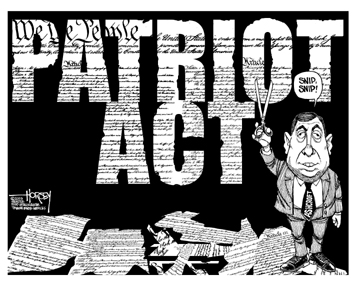
Important facts about the USA PATRIOT Act
In the book, evidence is presented that, for the most part, the mainstream media ignored serious issues and potential problems with the USA PATRIOT Act, passed shortly after the 9/11 terrorist attacks and meant to be temporary law. I show how there were literally only a handful of stories on the law.
Even those provided no context about the law -- who wrote it, what did it do, how did it change our civil liberties, was it worth the loss of freedom, would it actually keep it safer, etc. Thus, there was little critical coverage of the law, suggesting the media failed in their role of watchdog of the powerful.
Well, the law is still with us (just renewed again without privacy provisions in place for another year by Congress and President Obama). And the problems with the law remain. Yet, there is almost no coverage of these issues in the inner-ring/uper-tier media.
Luckily, organizations like these allow us to learn more about the law. But to learn the truth, you have to go to these sources, for the media are simply not covering the story.
Spend some time there and learn the facts.
http://epic.org/privacy/terrorism/usapatriot/
http://w2.eff.org/patriot/
http://www.aclu.org/national-security/usa-patriot-act
Even those provided no context about the law -- who wrote it, what did it do, how did it change our civil liberties, was it worth the loss of freedom, would it actually keep it safer, etc. Thus, there was little critical coverage of the law, suggesting the media failed in their role of watchdog of the powerful.
Well, the law is still with us (just renewed again without privacy provisions in place for another year by Congress and President Obama). And the problems with the law remain. Yet, there is almost no coverage of these issues in the inner-ring/uper-tier media.
Luckily, organizations like these allow us to learn more about the law. But to learn the truth, you have to go to these sources, for the media are simply not covering the story.
Spend some time there and learn the facts.
http://epic.org/privacy/terrorism/usapatriot/
http://w2.eff.org/patriot/
http://www.aclu.org/national-security/usa-patriot-act
Tuesday, January 25, 2011
Recent rash of police shootings nationwide
A recent rash of police shootings nationwide?
So says CNN.
In the book I show that stories about crime and criminal justice rarely offer important context. That is, they typically fail to show the important details needed to give the story meaning.
Here is an example of the opposite. Even the headline offers context:
"Dangers real, but deaths increasingly rare for police officers."
Exactly. It is a dangerous job. But officers are rarely killed on the job.
As noted in the article: "Police shootings are very, very rare events in this country," said Peter Manning, a professor at Northeastern University's College of Criminal Justice. "When they happen together (like this week), it's even rarer."
With this context -- if the news and entertainment media just showed cops being killed -- we'd all carry around misconceptions of the realities of police work.
Kudos to CNN for providing this context.
As for me this one hits way too close to home. Two officers in my hometown of St. Pete slaughtered in an ambush. It's a horribly sad day.
http://www.cnn.com/2011/CRIME/01/25/police.officers.shot/
So says CNN.
In the book I show that stories about crime and criminal justice rarely offer important context. That is, they typically fail to show the important details needed to give the story meaning.
Here is an example of the opposite. Even the headline offers context:
"Dangers real, but deaths increasingly rare for police officers."
Exactly. It is a dangerous job. But officers are rarely killed on the job.
As noted in the article: "Police shootings are very, very rare events in this country," said Peter Manning, a professor at Northeastern University's College of Criminal Justice. "When they happen together (like this week), it's even rarer."
With this context -- if the news and entertainment media just showed cops being killed -- we'd all carry around misconceptions of the realities of police work.
Kudos to CNN for providing this context.
As for me this one hits way too close to home. Two officers in my hometown of St. Pete slaughtered in an ambush. It's a horribly sad day.
http://www.cnn.com/2011/CRIME/01/25/police.officers.shot/
Monday, January 10, 2011
Mental illness and crime
As noted in the book, when the media cover crime, they do it in a certain, predicatble way.
Take this article in Time magazine, for example. http://www.time.com/time/nation/article/0,8599,2041448,00.html?hpt=T2
The violent act is linked to gun control.
And to mental illness.
And to previous violent assaults by people with mental disorders.
Including the Va Tech massacre.
(even though it is in no way connected to that event)
They even raise the issue of how this man's drug use may be to blame asking you to: Read about the link between marijuana and schizophrenia.
(he used marijuana, by the way, a drug that lessons violent impulses not brings them on)
And the question of the article is, why are the mentally ill armed?
Not, why are people mentally ill?
Not, why don't we do a better job of treating people with mental illness?
Not even, do mentally ill people usually get violent? If not, what conditions lead to violence among the mentally ill.
In other words, the proper context is not being provided.
And the context being provided is the wrong one.
Here are the facts about mental illness and crime:
1) Most mentally ill people are not violent
2) Violence is more common in mentally ill people only under certain circumstances:
a) The person is suffering from psychosis and/or delusions
b) The person is abusing drugs (usually as a form of self-medication)
c) The person is not being treated
3) The mentally ill are overrepresented in criminal justice populations not because they commit more crime but because they cannot find effective treatment in their communities.
That is the story the media should be telling.

Take this article in Time magazine, for example. http://www.time.com/time/nation/article/0,8599,2041448,00.html?hpt=T2
The violent act is linked to gun control.
And to mental illness.
And to previous violent assaults by people with mental disorders.
Including the Va Tech massacre.
(even though it is in no way connected to that event)
They even raise the issue of how this man's drug use may be to blame asking you to: Read about the link between marijuana and schizophrenia.
(he used marijuana, by the way, a drug that lessons violent impulses not brings them on)
And the question of the article is, why are the mentally ill armed?
Not, why are people mentally ill?
Not, why don't we do a better job of treating people with mental illness?
Not even, do mentally ill people usually get violent? If not, what conditions lead to violence among the mentally ill.
In other words, the proper context is not being provided.
And the context being provided is the wrong one.
Here are the facts about mental illness and crime:
1) Most mentally ill people are not violent
2) Violence is more common in mentally ill people only under certain circumstances:
a) The person is suffering from psychosis and/or delusions
b) The person is abusing drugs (usually as a form of self-medication)
c) The person is not being treated
3) The mentally ill are overrepresented in criminal justice populations not because they commit more crime but because they cannot find effective treatment in their communities.
That is the story the media should be telling.
Subscribe to:
Posts (Atom)